Quick answer
<p>Our overall pick is the Brooks Cascadia 19, which lists a TrailTack Green outsole, DNA LOFT v3 cushioning and a reinforced toe cap for mixed trail terrain. Runners planning long days may look at the Brooks Caldera 8, while those who face wet weather and climbs may prefer the adidas Terrex Tracefinder 2 Climaproof.</p>
If you are looking for the best trail running shoes for dirt paths, rocky singletrack or mixed wet and dry routes, this roundup compares 14 models using the details each manufacturer lists on Amazon. We focus on outsole traction, cushioning, upper protection, weather features and fit notes so you can narrow the field before you shop.
Quick picks
- Start here: Brooks Cascadia 19 (see on Amazon)
- Long-distance comfort: Brooks Caldera 8 (see on Amazon)
- Wet weather and climbs: adidas Terrex Tracefinder 2 Climaproof (see on Amazon)
- Wider fit: adidas Terrex Rockadia (see on Amazon)
14 Best Trail Running Shoes for Runners compared
| # | Product | Best for | Color | Size | Weight |
|---|---|---|---|---|---|
| 1 | Brooks Cascadia 19 | Best overall | Black/Black/Ebony | 12 (title: 12 Medium) | Not listed |
| 2 | ALTRA Lone Peak 8 | Best for trail-to-casual wear | Black/Gray | 11 | Not listed |
| 3 | New Balance Fresh Foam X Hierro V9 | Best for deep lugs on wet and dry trails | Afterglow/Dark Olivine | 9 | 1.0 pounds |
| 4 | Brooks Ghost Trail | Best for dry, rocky terrain | Gray/Gray/Bleached Sand | 11 | 1.85 pounds |
| 5 | Saucony Excursion TR16 | Best for carbon-rubber lug traction | Black/Charcoal | 10.5 (title: 10.5 Medium) | 1.93 pounds |
| 6 | Brooks Caldera 8 | Best for long-distance cushioning | Dusty Olive/Lime/Oyster | 10 | 1.32 pounds |
| 7 | ALTRA Experience Wild 2 | Best for a balanced heel-to-toe platform | Dusty/Olive | 10.5 | Not listed |
| 8 | New Balance DynaSoft Nitrel V6 | Best for responsive DynaSoft cushioning | Raincloud/Deep Sea/Firefly | 8.5 | 1.5 pounds |
| 9 | adidas Terrex Tracefinder 2 Climaproof | Best for uphill climbs with Climaproof | Olive Strata/Black/Semi Impact Orange | 10 | Not listed |
| 10 | adidas Terrex Rockadia | Best wide-fit option | Black/Carbon/Black | 13 | Not listed |
| 11 | Under Armour Charged Bandit Trail 4 | Best for a fully waterproof membrane | (016) Anthracite/Orange Oxide/Capri | 8.5 | Not listed |
| 12 | New Balance 410 V9 | Best for mixed road and trail use | Castlerock/Black | 9.5 | 1.74 pounds |
| 13 | adidas Terrex Eastrail 3 | Best for a straightforward trail option | Black/Carbon/Grey | 10 | Not listed |
| 14 | NORTIV 8 Men’s Trail Running Shoe | Best for walking and hiking use | Black/Army Green | 13 | Not listed |
How we chose
We compared manufacturer listings and Amazon specifications as of November 2026. We did not test any of these shoes hands-on, so every claim here comes from what the listing states. Our criteria were the outsole and traction details, cushioning and midsole notes, upper and toe protection, weather features, fit or width notes, and core specs such as color, size and weight.
Where a listed weight looked inconsistent with the rest of the listing, we left it out rather than repeat it. Labels are based on the features each listing emphasizes, and the order follows our overall pick first.
Best for technical and rocky trails
These models emphasize grip, lugs and toe protection for uneven, rocky or root-filled ground.
1. Best overall: Brooks Cascadia 19

Pros
- TrailTack Green outsole listed for uneven wet and dry conditions
- Reinforced toe cap and mudguard for upper protection
- Trail Adapt System with Ballistic Rock Shield
Cons
- The listing does not mention a weight we could confirm
Brooks lists the Cascadia 19 for trail runners who want confidence on varied terrain. It has a TrailTack Green outsole made from 25% recycled content, nitro-infused DNA LOFT v3 cushioning in the heel and forefoot, and a reinforced toe cap and mudguard. The updated Trail Adapt System with a flexible Ballistic Rock Shield is described as adding stability.
Best for: Runners who want one trail shoe for mixed wet and dry terrain with extra toe protection.
2. Best for trail-to-casual wear: ALTRA Lone Peak 8

Pros
- MaxTrac outsole with TrailClaw lugs
- Ripstop mesh upper described as abrasion-resistant
- EGO midsole listed for energy return
Cons
- The listing does not mention a weight or heel-to-toe drop
- The listing does not mention waterproofing
ALTRA describes the Lone Peak 8 as an adventure-ready design that moves from rugged trails to casual wear. The MaxTrac outsole with TrailClaw lugs is listed for dirt, gravel and rock. A reinforced ripstop mesh upper is called abrasion-resistant and breathable, and a lightweight EGO midsole is noted for high-rebound energy return.
Best for: Runners who want one shoe for trail days and everyday wear.
3. Best for deep lugs on wet and dry trails: New Balance Fresh Foam X Hierro V9

Pros
- Vibram MegaGrip outsole with 6mm lugs
- Reinforced toe cap for rocks and roots
- Gusseted tongue listed to keep out debris
Cons
- The listing does not mention waterproofing
New Balance lists the Hierro V9 with a dual-density Fresh Foam X midsole, combining a softer top layer with a firmer base. The Vibram MegaGrip outsole has a revamped tread pattern and 6mm lugs. A reinforced toe cap is described as shielding feet from rocks and roots, and an engineered knit upper with a gusseted tongue is noted for keeping out debris.
Best for: Runners who want listed 6mm lugs and toe protection on technical, rocky ground.
4. Best for dry, rocky terrain: Brooks Ghost Trail

Pros
- Nitrogen-infused DNA LOFT v3 midsole
- 3D-printed overlays at toe cap and mudguard
- Air mesh upper for airflow
Cons
- Listed 3mm lugs are shallower than the 6mm lugs on the New Balance Hierro V9
- The listing does not mention waterproofing
Brooks positions the Ghost Trail as an off-road shoe in the Ghost series, engineered for dry, rocky and technical ground. Its TrailTack Green outsole has 3mm lugs, and a nitrogen-infused DNA LOFT v3 midsole is described as plush without losing responsiveness. An air mesh upper is paired with 3D-printed overlays at the toe cap and mudguard.
Best for: Runners who want Ghost-series comfort on rocky trails and some hiking use.
5. Best for carbon-rubber lug traction: Saucony Excursion TR16

Pros
- Carbon-rubber lugs described as grippy
- VERSARUN cushioning listed for all-day comfort
- Styling the listing says goes beyond the outdoors
Cons
- The listing gives little detail on the upper, drop or toe protection
Saucony lists the Excursion TR16 with VERSARUN cushioning for balanced comfort through the day. Its carbon-rubber lugs are described as grippy and suited to many terrain types. The listing also highlights fresh design details that add trail protection with a look that goes beyond the outdoors.
Best for: Runners who want a grippy, all-day trail shoe with a casual look.
Best for long days and plush cushioning
These listings focus on stacked or highly cushioned midsoles for longer efforts on the trail.
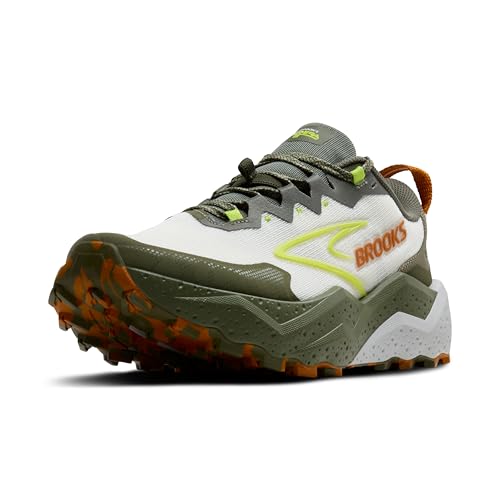
6. Best for long-distance cushioning: Brooks Caldera 8
Pros
- Stacked DNA LOFT v3 cushioning listed for rough terrain
- Raised sidewalls for added security
- Air mesh with breathable TPEE top layer
Cons
- The listing does not mention a heel-to-toe drop
Brooks calls the Caldera 8 an ultra trail shoe built for distance. Its stacked, nitrogen-infused DNA LOFT v3 cushioning is described as plush enough to protect against rocks and roots. Raised sidewalls add security, while an elevated upper pairs air mesh with a breathable TPEE top layer. The widened base and flex grooves are listed to stabilize landings.
Best for: Runners planning long days on rough, rocky or rooted trails who want plush cushioning.
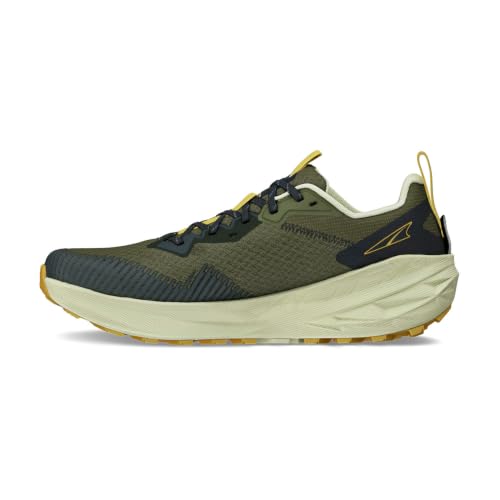
7. Best for a balanced heel-to-toe platform: ALTRA Experience Wild 2
Pros
- Balanced platform with equal heel and forefoot height
- FootShape toe box lets toes spread
- Highly cushioned midsole for hard trail days
Cons
- The listing shows Number Of Items: 2, so check the quantity before ordering
- The listing does not mention outsole traction details
ALTRA describes the Experience Wild 2 with a Balanced Cushioning platform that places the heel and forefoot the same distance from the ground, which the listing says encourages low-impact landings. A highly cushioned midsole is meant for high-intensity trail days. The signature FootShape toe box is noted for letting toes spread.
Best for: Runners who want the even platform and roomy toe box that ALTRA describes.
8. Best for responsive DynaSoft cushioning: New Balance DynaSoft Nitrel V6

Pros
- DynaSoft midsole for responsive, plush feel
- AT Tread outsole for on- and off-road use
- EVA foam insert listed for comfort
Cons
- The listing does not describe upper breathability or lug depth
New Balance describes the DynaSoft Nitrel V6 with a DynaSoft midsole that the listing says pairs ultra-responsive performance with plush comfort. The AT Tread outsole is noted for traction on and off road. An EVA foam insert adds comfort, and the listing mentions no-sew overlays in the upper.
Best for: Runners who want responsive cushioning with versatile on- and off-road grip.
Best for wet weather and wider fits
These options call out waterproof or moisture-blocking features, or a wide fit.
9. Best for uphill climbs with Climaproof: adidas Terrex Tracefinder 2 Climaproof

Pros
- CLIMAPROOF listed to block outside moisture
- TRAXION rubber with aggressive lugged tread
- LIGHTMOTION foam described for uphill climbs
Cons
- The listing does not mention a weight we could confirm
adidas lists the Tracefinder 2 as a lightweight trail shoe with CLIMAPROOF technology that blocks outside moisture while letting sweat escape. The listing calls the system wind-resistant yet breathable. Softer LIGHTMOTION foam is described as supportive across uneven ground, and TRAXION rubber with an aggressive lugged tread is noted for loose dirt and wet roots.
Best for: Runners who face wet weather and steep climbs on varied trails.
10. Best wide-fit option: adidas Terrex Rockadia

Pros
- Wide fit listed
- Full-length Adiwear outsole for durability
- Lace closure and textile and synthetic upper
Cons
- The listing gives few cushioning or traction details
adidas lists the Rockadia as a trail running shoe with a wide fit, a lace closure and a textile and synthetic upper. A full-length Adiwear outsole is described as adding durability for trail adventures. The listing gives a width of 9.0 inches and a listed size of 13.
Best for: Runners who need a wide fit and a full-length, durable outsole.
11. Best for a fully waterproof membrane: Under Armour Charged Bandit Trail 4

Pros
- Waterproof membrane described as 100% waterproof
- Warp knit upper listed for ventilation
- Molded sockliner described to limit slippage
Cons
- The listed color does not match the title (016 Gray)
- The listing does not describe an outsole or lug depth
Under Armour lists the Charged Bandit Trail 4 Waterproof with a breathable membrane that the listing says is 100% waterproof while still letting sweat escape. A lightweight warp knit upper is noted for ventilation, and strategic PU overlays add durability in high-abrasion areas. A molded sockliner is described as forming to the foot to limit slippage.
Best for: Runners who want a waterproof layer paired with a ventilated upper.
Best for walking, hiking and everyday trail use
These models are described for a mix of trail running, hiking, walking and everyday wear.
12. Best for mixed road and trail use: New Balance 410 V9

Pros
- AT Tread outsole for on- and off-road use
- BIO Foam midsole paired with Fresh Foam
- Reinforced overlays and breathable mesh upper
Cons
- The listing does not mention a dedicated toe cap
- The listing does not describe lug depth
New Balance describes the 410 V9 as an all-terrain shoe for both on-road and off-road activities, from trail runs to hiking. Its midsole pairs Fresh Foam with BIO Foam, which the listing says works together to reduce fatigue. Reinforced overlays and a breathable mesh upper are noted for durability and airflow on long trail sessions.
Best for: Runners who split time between roads and trails, or who also hike.
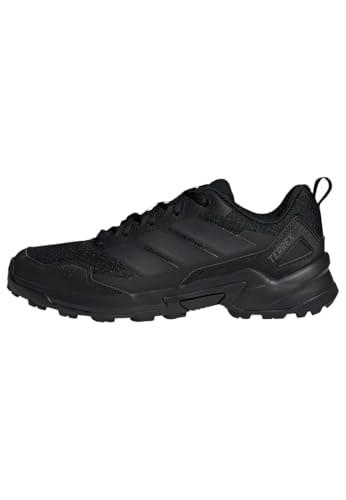
13. Best for a straightforward trail option: adidas Terrex Eastrail 3
Pros
- Part of the adidas Terrex trail line
- Listed in size 10
- Simple listing with few claims to weigh
Cons
- The listing does not describe cushioning, outsole or upper materials
- The listing color (Black/Carbon/Grey) does not match the title (Black/Black/Grey)
The adidas Terrex Eastrail 3 listing is brief. It names the adidas Terrex Eastrail 3, lists a color, a size of 10 and a weight, and includes little else. The listing does not describe a cushioning system, outsole, upper or drop, so readers should check the full product details before buying.
Best for: Readers who already know this adidas model and want a size 10 black trail shoe.
14. Best for walking and hiking use: NORTIV 8 Men’s Trail Running Shoe

Pros
- 4mm multi-directional traction lugs
- TPU toe listed for protection
- Breathable mesh upper for airflow
Cons
- The listing does not state a weight
- The listing does not give width or drop details
NORTIV 8 positions this men’s shoe for walks, hikes and workouts as well as trail running. A flexible EVA midsole is described as lightweight with energy return, and a full rubber outsole carries 4mm multi-directional traction lugs. A TPU toe is listed for protection against roots and bumps, and the breathable mesh upper aims to keep feet cool and dry.
Best for: Readers who want one shoe for walks, hikes and light trail running.
How to choose the best trail running shoes
Start with the terrain you run most. Trail listings usually describe outsole lugs, cushioning and upper protection, and those are the details to compare first. A shoe built for rocky, technical trails may feel different from one aimed at mixed dirt and gravel paths. For a fuller breakdown, read Essential Features of Trail Running Shoes.
Next, look at protection. Reinforced toe caps and mudguards appear on several of these models and can matter on roots and loose rock. Gusseted tongues and overlays are listed on others and are described as keeping debris out or reducing wear. Treat these as listed features rather than guarantees.
Weather is the third question. Some models list waterproof membranes, while others list moisture-blocking systems that still let sweat escape. A waterproof layer can feel warmer on hot days than an open mesh upper, so think about when and where you usually run.
Fit matters as much as features. Some listings mention a wide fit or a toe box designed to let toes spread. If you have wide feet, check the listed width and the manufacturer’s size guidance before you order. Also check the quantity in the listing, since one entry shows two items.
Use listing data as a starting point, not a final verdict. For how shoe categories differ, see Running Shoe Types Explained, and browse related options in Running Shoe Types.
What to look for
- Outsole type and lug description matched to your usual surfaces
- Cushioning and midsole details that fit your long-run needs
- Upper protection, such as toe caps, overlays and ripstop mesh
- Weather features: waterproof membranes or moisture-blocking systems
- Width or toe box notes, plus the listed size and color
- Listing consistency: check title, color and quantity before buying
FAQ
Are trail running shoes necessary for packed dirt paths?
Not always. Trail shoes are designed for uneven, loose or muddy ground. If your routes are mostly paved or smooth packed dirt, a road shoe may suit you better. Compare categories in Running Shoe Types.
Is a waterproof trail shoe always the better choice?
Not necessarily. A waterproof membrane can help in wet conditions, but it can also feel warmer in hot weather than a mesh upper. The Under Armour listing says its membrane still lets sweat escape, so choose based on where and when you run.
How should I check fit before ordering?
Check the listed size, width and any toe box notes, and compare them with the manufacturer’s size chart. Several listings here do not give dimensions, so the manufacturer’s guidance is your best source. For general activity guidance, see the federal physical activity guidelines.
References
- Amazon product listings and manufacturer specifications (accessed November 2026)
- Physical Activity Guidelines, Office of Disease Prevention and Health Promotion