Quick answer
Our overall pick is the Beats Powerbeats Pro 2, which lists active noise cancelling, built-in heart rate sensors and up to 45 hours of total listening with its charging case. Runners who need to hear their surroundings may prefer the open-ear SHOKZ models, while those who train in sweat or rain may look at the JBL Endurance Race 2 or Soundcore Sport X20, both listed at IP68.
Searching for the best running earbuds can mean sorting through in-ear sets, open-ear clips and bone conduction headphones that all claim to suit runners. This roundup is for readers who are new to the sport and want to match gear to how they train. If you are still building your routine, our Getting Started section is a good place to begin.
Quick picks
- Best overall: Beats Powerbeats Pro 2 (see on Amazon)
- Best for wet, dusty workouts: JBL Endurance Race 2 (see on Amazon)
- Best open-ear with headband bundle: SHOKZ OpenRun (see on Amazon)
- Best for wearing with glasses: DECHOYECHO O2 open-ear (see on Amazon)
13 Best Running Earbuds compared
| # | Product | Best for | Color | Weight | Water rating (as listed) |
|---|---|---|---|---|---|
| 1 | Beats Powerbeats Pro 2 | Best overall | Jet Black | 0.32 lb | Sweat and water resistant; IPX4 in features |
| 2 | JBL Endurance Race 2 | Best for wet, dusty workouts | Blue | 0.12 lb | IP68 |
| 3 | Soundcore Sport X20 by Anker | Best for adjustable ear hooks | Black | 0.13 lb | IP68 |
| 4 | JLab Go Sport+ | Best for small ears with built-in cable | Graphite | Not listed (listed information not usable) | IP55 |
| 5 | JBL Vibe Beam | Best for a comfortable stick fit | Black | 0.10625 lb | Not listed |
| 6 | Ordtop Sport wireless earbuds | Best for long total battery life | A-Pure Black | 0.0772 lb | IPX8 |
| 7 | SHOKZ OpenRun Pro 2 | Best open-ear with EQ modes | Black | 0.0668 lb | IP55 |
| 8 | SHOKZ OpenRun | Best open-ear with headband bundle | Black | 0.0573 lb | IP67 |
| 9 | SHOKZ OpenMove | Best for light jogs and commutes | Grey | 0.0639 lb | Sweatproof; no IP rating listed |
| 10 | PSIER bone conduction headphones | Best for Bluetooth 6.0 pairing | Black | 23 g (feature text) | IPX5 |
| 11 | SHOKZ OpenRun Pro 2 Mini | Best smaller-fit open-ear option | Black | 0.0661 lb | IP55 |
| 12 | Soundcore V20i by Anker | Best open-ear with long battery | Black | 0.168 lb | IP55 |
| 13 | DECHOYECHO O2 open-ear | Best for wearing with glasses | Black | 26.4 g (feature text) | Not listed |
How we chose
We compared manufacturer listings and specifications on Amazon as of November 2026. We did not test any of these products hands-on, so every fact in this article comes from the listing data, and we left out spec values that looked implausible or contradicted the listing title.
Our criteria were the fit and security features each listing describes, the form type (in-ear, open-ear or bone conduction), any water and dust ratings shown, battery claims as written, and extras such as heart rate sensing, noise cancelling or app-based EQ. Where a listing did not state a detail, we say so instead of assuming it.
In-ear earbuds for sweaty, wet workouts
These in-ear and closed designs focus on fit, sealed ratings and battery life for training that involves sweat or water.
1. Best overall: Beats Powerbeats Pro 2

Pros
- Active noise cancelling with Transparency mode, per listing
- Built-in heart rate sensors, no chest strap needed
- Up to 45 hours total with the charging case
Cons
- Heaviest listed weight in this roundup at 0.32 pounds
- Listing does not mention a dust rating
The Powerbeats Pro 2 is an in-ear set with an earhook that the listing says stays locked on during sprints and hard workouts. Its active noise cancelling is designed for training environments, and Transparency mode lets outside sound in when you need it. Built-in sensors track heart rate without a chest strap, and the listing states up to 45 hours of total listening with the Qi-charging case.
Best for: Runners who want in-ear sound with noise cancelling and heart rate sensing in one set.
2. Best for wet, dusty workouts: JBL Endurance Race 2

Pros
- IP68 rated for dust and water
- Twistlock wing enhancer for a better seal
- 12 hours per charge plus three more full charges in the case
Cons
- Charging case is not waterproof per listing; dry the buds and case before charging
- Listing does not mention noise cancelling
The JBL Endurance Race 2 carries an IP68 rating for dust and water. The listing notes that the charging case is not waterproof, so the earbuds should be dried before they go back in to charge. Its ergonomic wing enhancer uses Twistlock technology for a better seal, and the listing gives 12 hours of playtime per charge plus three more full charges in the case.
Best for: Runners who sweat heavily or train in rain and dust and want a rating printed in the listing.
3. Best for adjustable ear hooks: Soundcore Sport X20 by Anker

Pros
- Rotatable and extendable ear hooks
- Manual and adaptive ANC for noisy gyms
- IP68 waterproof and sweatproof per listing
Cons
- Listing does not mention heart rate tracking
- Listing does not mention a Transparency mode
The Sport X20 has rotatable and extendable ear hooks, with the listing citing up to 30 degrees of rotation and 4mm of extension. It offers noise cancelling for loud gyms, with manual and adaptive ANC modes. Its 11mm dynamic drivers and BassUp technology are aimed at strong bass, and the SweatGuard design is described as a sealed structure that protects internal parts from sweat and water. The listing gives a 48-hour playtime.
Best for: Runners who want to fine-tune the fit of their earhooks and also block out gym noise.
4. Best for small ears with built-in cable: JLab Go Sport+

Pros
- Built-in USB cable in the case, no extra cord
- Earhook sized for small ears, per listing
- Dual Connect lets you use either earbud alone
Cons
- Listing gives 9+ hours per earbud, less than the Endurance Race 2's 12 hours
- The listed weight is not usable, so check the product page
The Go Sport+ has an ergonomic earhook that the listing says is sized to fit even the smallest ears, plus an IP55 rating for sweat and dust. The built-in USB cable in the case means no extra cord is needed. Listed EQ modes are Signature, Balanced and Bass Boost, and C3 Clear Calling uses dual MEMS mics. Dual Connect lets you use either earbud on its own.
Best for: Runners with smaller ears who want a cable built into the charging case.
5. Best for a comfortable stick fit: JBL Vibe Beam

Pros
- Stick-style design built for comfort
- VoiceAware for hands-free calls
- Up to 32 hours total with the case
Cons
- Listing does not mention a water or sweat rating
- Closed design excludes external sounds, so you hear less of your surroundings
The Vibe Beam uses a stick-style, closed design that the listing says fits so comfortably you may forget you are wearing them. It has 8mm drivers with JBL Deep Bass Sound and VoiceAware for hands-free calls. The listing describes up to 32 hours of total battery life, with 8 hours in the earbuds and 24 in the case, and speed charging. It comes in black.
Best for: Runners who prefer a stick-style earbud that sits quietly and want a long total listed battery.
6. Best for long total battery life: Ordtop Sport wireless earbuds

Pros
- IPX8 waterproof rating listed
- Up to 70 hours total with the case, per listing
- LED power display and USB-C fast charging
Cons
- Listing mixes earbud and over-ear wording, so the form factor is unclear
- Listing does not mention heart rate tracking
The Ordtop Sport wireless earbuds have earhooks and an IPX8 waterproof rating, and the listing says a nano-coating helps keep water and sweat from penetrating. They use Bluetooth 5.4 and four ENC microphones. The listing describes 14 hours from a single charge, up to 70 hours total with the case, plus an LED power display and USB-C fast charging. The listed color is A-Pure Black.
Best for: Runners who want a very long total listed battery with an IPX8 rating and an LED display.
Bone conduction for staying aware outdoors
Bone conduction models sit outside the ear canal, which suits readers who want to keep hearing their surroundings.
7. Best open-ear with EQ modes: SHOKZ OpenRun Pro 2

Pros
- 12 hours of battery listed
- Shokz app EQ modes, including Classic Mode
- Smart Mic for calls
Cons
- Listed IP55 rating is lower than the IP67 OpenRun and IP68 models in this roundup
- Listing does not mention a sweat headband
The OpenRun Pro 2 pairs bone conduction and air conduction drivers, and the listing describes an open-ear design that keeps you aware of your surroundings. Its unibody frame uses a Ni-Ti alloy memory wire for a secure fit. The Shokz app offers EQ modes, including a Classic Mode and a mode that boosts audio in noisy places. The listing also includes a Smart Mic and 12 hours of battery.
Best for: Runners who want open-ear awareness plus app-based EQ control and a long listed battery.
8. Best open-ear with headband bundle: SHOKZ OpenRun

Pros
- IP67 rating listed
- Sweat headband included in the bundle
- Quick charge for up to 1.5 hours of battery life
Cons
- Listed battery is 8 hours, shorter than the OpenRun Pro 2's 12 hours
- Listing does not mention EQ modes
The OpenRun uses bone conduction in a featherweight, wraparound frame, and the listing describes eighth-generation bone conduction technology. It is rated IP67 and the bundle includes a Shokz sweat headband. The listed battery is 8 hours, and a 10-minute quick charge is described as giving up to 1.5 hours of battery life. The listing names a standard size with magnetic charging.
Best for: Runners who want a lightweight open-ear design with a sweat headband included.
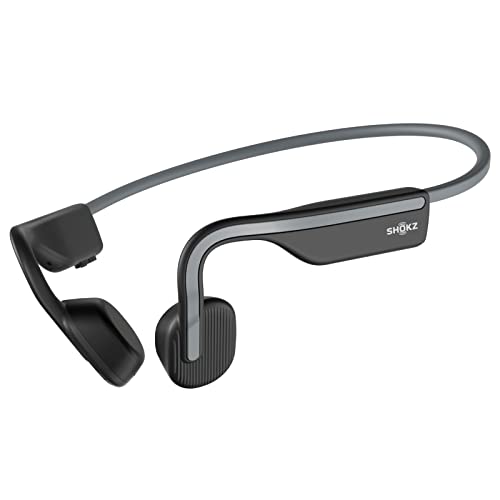
9. Best for light jogs and commutes: SHOKZ OpenMove
Pros
- Wraparound titanium frame
- Six hours of music, calls and podcasts per charge
- Pairs with Android, iOS, Windows and other Bluetooth devices
Cons
- Listing describes low-impact use, so it suits light jogs more than hard training
- Listing does not mention an IP rating
The OpenMove is a bone conduction headphone with a wraparound titanium frame and an earbud-free design. The listing describes it as sweatproof and built for low-impact activities, from light jogs to everyday commutes. It gives six hours of music, calls and podcasts on a single charge and lists pairing with Android, iOS, Windows and other Bluetooth devices. It comes in grey and includes a sticker pack.
Best for: Runners who mostly jog lightly or commute and want an open-ear option with a titanium frame.
10. Best for Bluetooth 6.0 pairing: PSIER bone conduction headphones

Pros
- Bluetooth 6.0 for pairing and stable connection
- Weighs 23 g per listing
- IPX5 rating listed
Cons
- Listed playtime of up to 10 hours is at 50% volume
- Only Black is listed as a color
The PSIER uses bone conduction with a fully enclosed cavity design and a memory-titanium frame. The listing gives a weight of 23 grams and describes a stable fit for workouts. It supports Bluetooth 6.0 for instant pairing and includes a microphone for calls. The listing describes up to 10 hours of listening at 50% volume, and an IPX5 rating is shown.
Best for: Runners who want bone conduction headphones with the newest Bluetooth version listed.
11. Best smaller-fit open-ear option: SHOKZ OpenRun Pro 2 Mini

Pros
- Mini size of the Pro 2 line
- 12 hours of battery and Smart Mic listed
- Ni-Ti memory wire for a secure fit
Cons
- IP55 rating listed, not IP67 or IP68
- Listing does not mention a headband bundle
The OpenRun Pro 2 Mini is the Mini size of the Pro 2 line. It has a unibody frame, ergonomic ear hooks and a Ni-Ti alloy memory wire for a secure fit. The listing describes dual drivers with 12 hours of battery, a Smart Mic and Shokz app EQ modes. An IP55 rating is shown, and the bundle includes a reflective strip. It comes in black.
Best for: Runners who want the Pro 2 open-ear design in a Mini size.
Open-ear earbuds for all-day wear
These open-ear designs use adjustable or lightweight fits for longer sessions and everyday wear.
12. Best open-ear with long battery: Soundcore V20i by Anker

Pros
- Four adjustable positions for fit
- 36 hours total playtime listed
- Bluetooth 5.4 and multipoint connection
Cons
- Listed weight of 0.168 pounds is higher than the bone conduction models here
- Listing does not mention noise cancelling
The V20i is an open-ear earbud with four adjustable positions for fit. The listing describes 16mm drivers with titanium-coated domes and Soundcore’s BassUp technology. It carries an IP55 rating, Bluetooth 5.4 and multipoint connection, and the listing gives 36 hours of total playtime. Clear calls are mentioned in the title, and the design is described as non-intrusive for all-day wear.
Best for: Runners who want an open-ear fit they can adjust and a long total listed battery.
13. Best for wearing with glasses: DECHOYECHO O2 open-ear

Pros
- Open-ear design, with 26.4 g weight in listing text
- 12 hours of playtime with magnetic fast charge
- Dual device connection on Bluetooth 5.3
Cons
- Listing does not mention an IP or water rating
- Weight is shown only in feature text, not in the spec fields
The O2 is an open-ear air conduction headphone. The listing says it weighs 26.4 grams with a flexible titanium frame and sits outside the ear canal, which is described as suitable for glasses wearers. It has 15mm dynamic drivers, 12 hours of playtime, magnetic fast charge and Bluetooth 5.3 with dual device connection. The listing says it stays stable up to 33 feet.
Best for: Runners who wear glasses and want an open-ear fit that does not plug the ear canal.
How to choose the best running earbuds
Start with where you run. If you train in traffic, on trails or near other people, an open-ear or bone conduction design leaves your ear canals open so you can hear what is around you. If you train in a noisy gym or want more private sound, an in-ear model with a secure fit may suit you better. Our Getting Started section covers the basics of building a routine these tools can support.
Fit matters more than most specs. Look for features such as earhooks, rotatable hooks, a stick-style body or a memory-wire frame, and read what the listing says about staying in place during movement. For a broader look at building up to a run, see How to Start Running.
Water and dust ratings come next. IP codes describe protection against solid particles and liquids, so a listing that shows one gives you a documented number to compare. If a listing does not show a rating, do not assume protection. Follow the manufacturer’s manual for drying, charging and cleaning, especially where a charging case is listed as not waterproof.
Battery claims are written in different ways. Some listings give time per charge, others give total hours including the case. Compare the two numbers separately and check which one matches your typical week.
Finally, check the extras: weight as listed, color, heart rate sensing, noise cancelling, app-based EQ and multipoint pairing. Not every listing covers every feature, so a missing detail is worth noting rather than assuming. For other early mistakes to avoid, read Avoid These Common Mistakes When You Start Running.
What to look for
- Fit: earhooks, rotatable hooks, stick style or memory-wire frame, as the listing describes
- Open-ear vs in-ear: awareness of traffic and surroundings vs sound isolation
- Water and dust: the IP rating as listed; check the manual before drying or charging
- Battery: time per charge and total hours with the case, read separately
- Extras: heart rate sensing, noise cancelling, EQ modes and multipoint pairing, as listed
FAQ
Are open-ear headphones better for running outside?
Open-ear and bone conduction designs leave your ear canals open, and several listings say they help you stay aware of your surroundings. That can be useful outdoors, but it does not replace watching for traffic and following local rules. Follow the manufacturer’s manual for volume and use.
What does an IP rating tell me?
An IP code is a standard way to describe protection against dust and water. Our running terms and jargon explained guide is a good place to decode other gear labels. Use the rating in the listing as a starting point, and follow the manufacturer’s manual for drying, charging and cleaning.
Do these earbuds track heart rate?
Among these listings, only the Beats Powerbeats Pro 2 describes built-in sensors for real-time heart rate tracking. For the others, the listing does not mention heart rate tracking, so check the product page if that matters to you.
References
- Amazon product listings and manufacturer specifications (accessed November 2026)